Kurt Ankeny: American Toon
Project Space
September 3-27, 2026
Opening Reception: Friday, September 4, 5-8pm
Meet the Artists: Saturday, September 19, 2-4pm
Press Release
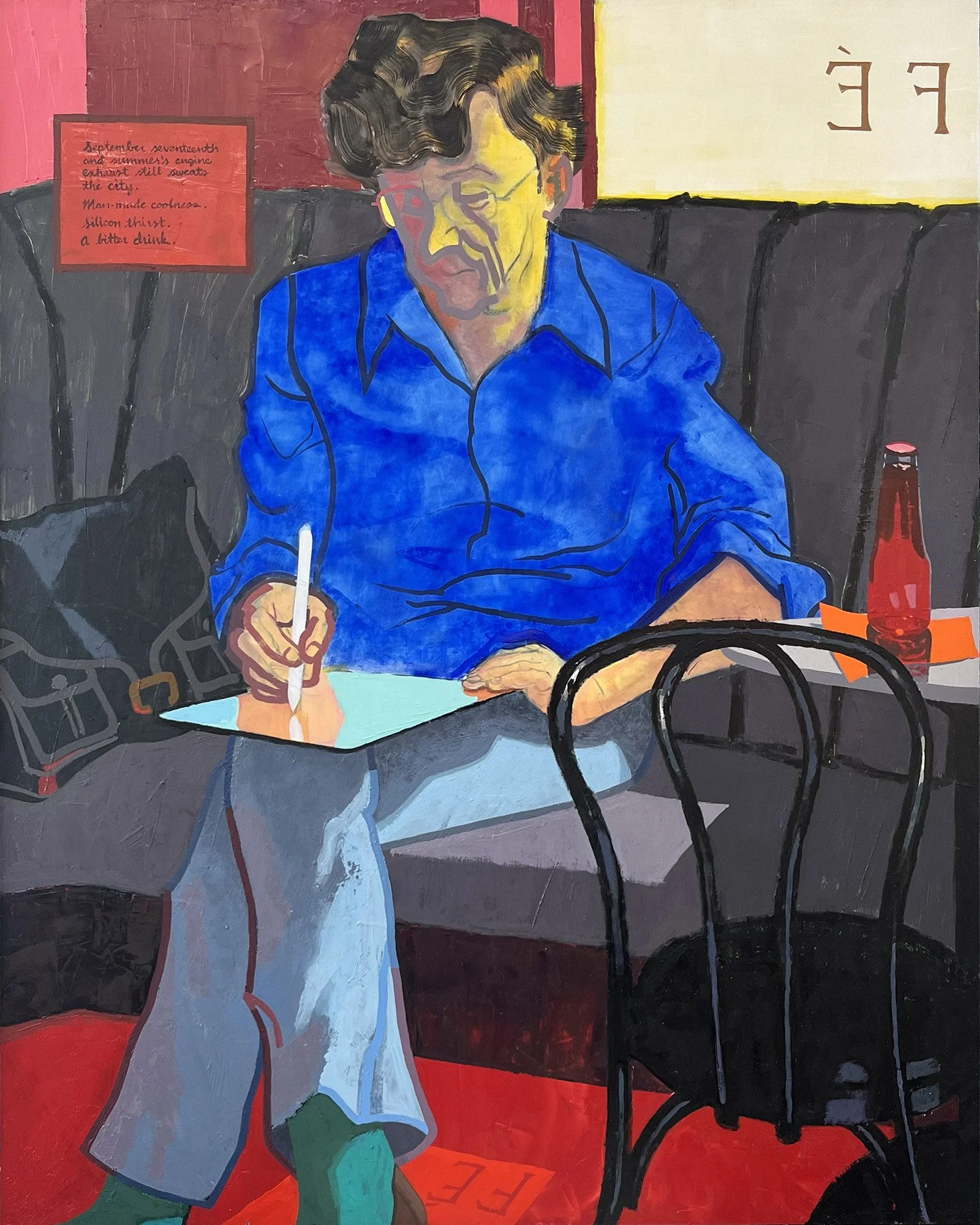
The Artificial Intelligence Architect, oil, grease pencil, paint stick on aluminum panel, 24 x 30 inches, 2025
My work develops from a long fascination with comics story-making. I believe deeply in the art form of comics, and they infuse my work. While mainstream comics themselves typically follow the three-act structure templates of novels and movies in their narratives, I find the way a poet or songwriter conveys a complex story economically much more interesting for my work. The interplay of elements in a song, for example, form a mode of storytelling where the melody, counterpoint, lyrics, and subtext all can shift, reinforce, undermine, or twist the meaning of the whole at any point during the piece.
To my mind, ever since the lens-image dominated the renaissance, painting (when it tries to be narrative) has become a story suggesting medium. It portrays a story’s representative scene, or it gives us a bitty taste of a tale. To build more narrative complexity into my images, I turn to Japanese scroll painting, comics, non-Western and pre-renaissance visual storytelling traditions looking for methods.
One method I’ve used in the past became clearer to me as I read the introduction to “The Mushroom at the End of the World” by Anna Lowenhaupt Tsing, where she says of her book, (emphasis mine)
The chapters build an open-ended assemblage, not a logical machine; they gesture to the so-much-more out there. They tangle with and interrupt each other—mimicking the patchiness of the world I am trying to describe. [...] My book then offers “third nature,” that is, what manages to live despite capitalism. [...] Like virtual particles in a quantum field, multiple futures pop in and out of possibility; third nature emerges within such temporal polyphony. Yet progress stories have blinded us. To know the world without them, this book sketches open-ended assemblages of entangled ways of life, as these coalesce in coordination across many kinds of temporal rhythms.
And even though I made a graphic novel using this principle, (2016’s In Pieces) it was not until I read that line that I realized that the structures in narrative and visual art that drove my interest were actually one and the same.
Progress stories have blinded us.
This is how I see it: the Western phenomenon of the three-act structure held up as the platonic ideal of story and photographs held up as images that are “true” have blinded us to the fact that these are not at all how we actually assemble stories or our visual sense of the world. Visually we hunt-and-peck at the world via eye saccades. Story-wise, life happens in snippets of threads that we later weave into longer yarns. But living in those stages of formation is a set of unresolved potentialities that I feel we truncate out of hubris rather than wisdom. Or, if I’m feeling generous, because the human mind evolved to jettison information ‘non-essential’ for survival.
Since I am first and foremost a visual storymaker, I seek to create similar unresolved situations in picture-stories, and the compressed and more open-ended story templates of poems and songs seem ideal to me for emulation in painting. To that end, I began to attempt to expand the mechanisms for story in painting, and one of my tactics is raiding the visual language of comics.
Comics aid my efforts to focus on pushing more layers into the visual frame, trying to cause more ambiguity and more contra-position in the image and its narrative. This is not a new endeavor, it has been part of image making since the very beginning—but it has fallen away and become regarded as some sort of “proto-painting”: an evolutionary byway on the path to Eurocentric, lens-based image ‘perfection’.
These works on view are what I feel are my first successful images of this endeavor. They are political, but when art becomes polemic it has a very brief shelf-life. These paintings are oblique statements, images with intended meaning but hopefully undisruptive of the mycelium of unconsciously-created subtexts that extend between me and all people who view the paintings.
I seek to fuse many image-making influences in my paintings. I have true love for the vigor of early-to-mid-20th-century brushwork, when painting was in the throes of its most violent reaction to photo technology. I have a strong affinity for linework that sometimes serves as a counterpoint to the form. I’ve introduced word balloons into my works as a way to let the characters within have a voice. Comics also accumulate meaning through a succession of images and while this group of paintings are mostly single-image works, they play off each other like nodes in a constellation, tangling with and interrupting each other—mimicking the patchiness of the situation we currently inhabit.
Artist Bio
Kurt Ankeny is an award-winning painter and cartoonist. He is represented by Boston’s artist-run Kingston Gallery, where he currently serves as Co-Director.
His work has appeared in Best American Comics, the Society of Illustrators, the Cape Ann Museum, the Fort Point Artist Community, Comics Workbook, PEN America’s Illustrated PEN, Ink Brick, and Fantagraphics’ NOW Anthology.
Prices available upon request. Contact marketing@kingstongallery.com
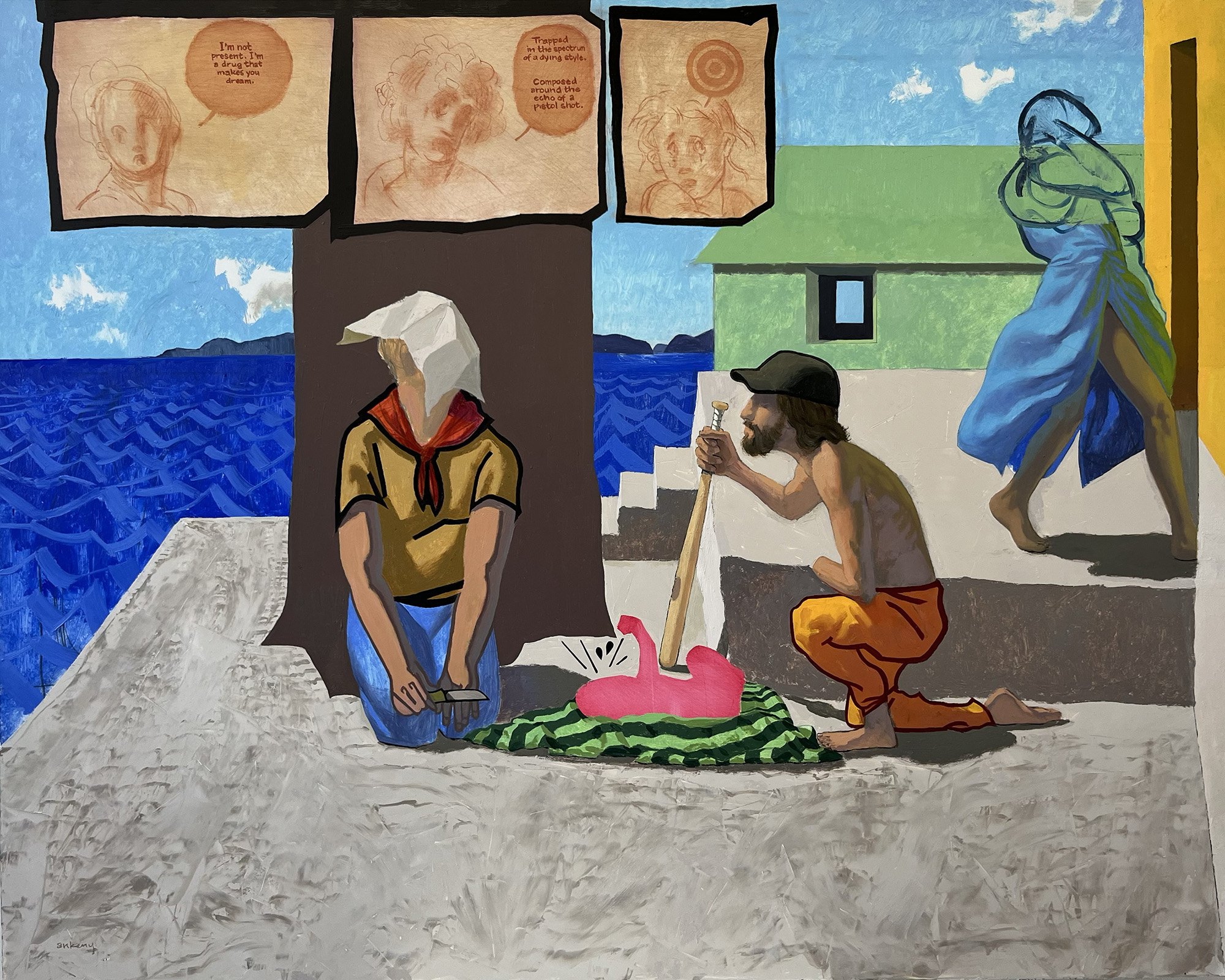
MOTI (Young, Durrell), oil, grease pencil, and sanguine on aluminum panel, 24 x 30 inches, 2026
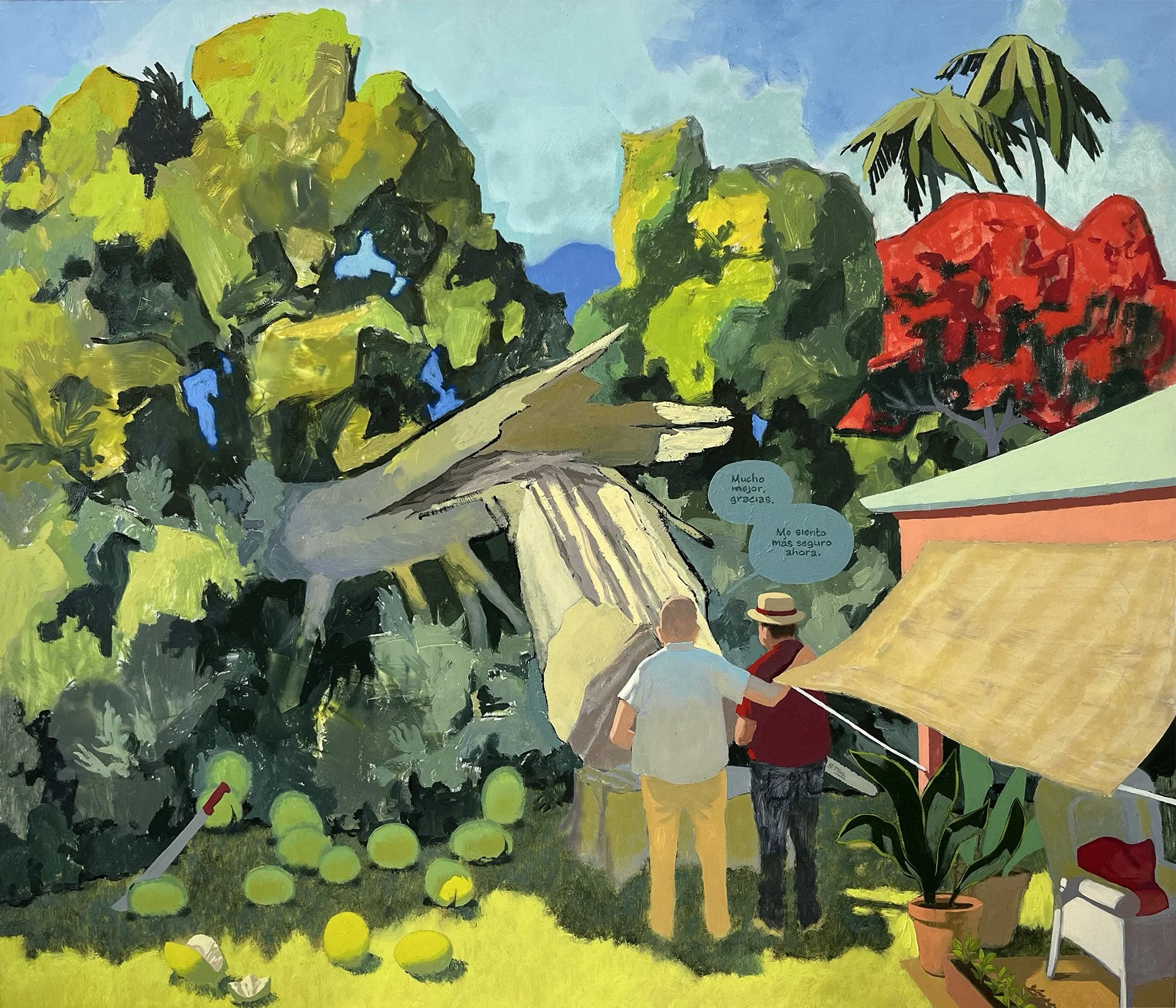
El Panapén, charcoal, oil, and grease pencil on aluminum panel, 24 x 28 inches, 2026
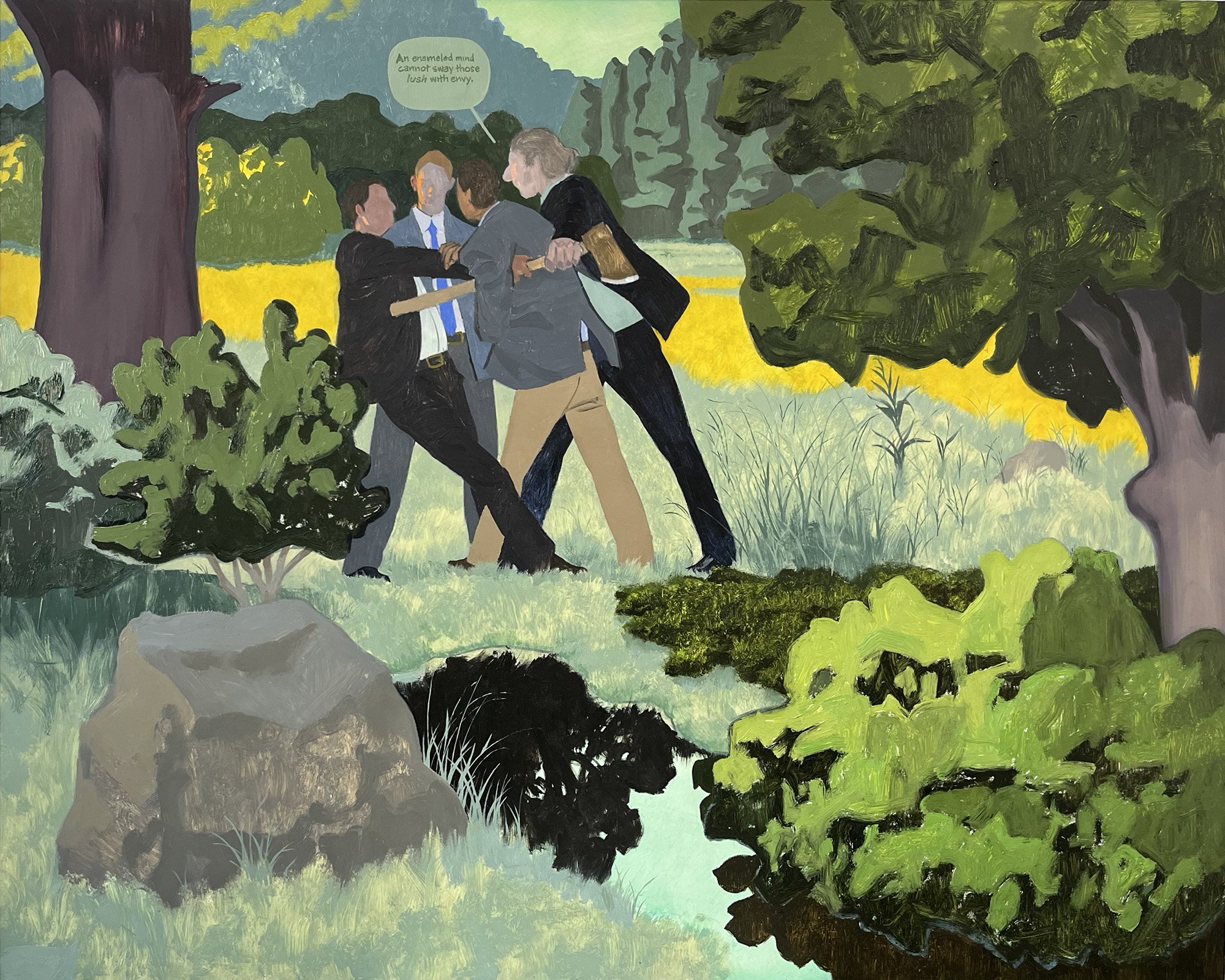
Struggling Businessmen, oil, grease pencil, and paint stick on aluminum panel, 24 x 30 inches, 2026
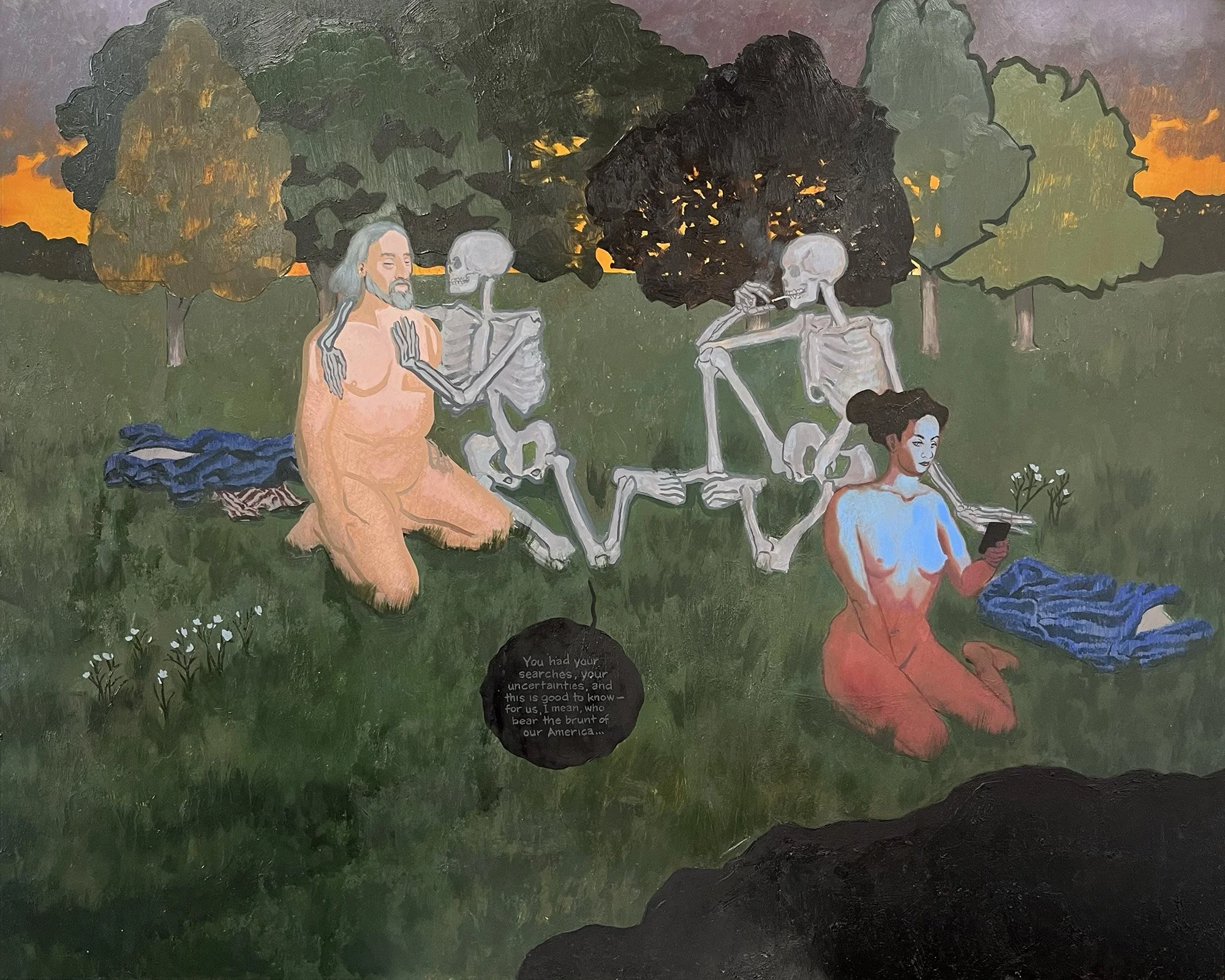
The Night Picnic (Pound), oil and grease pencil on aluminum panel, 24 x 30 inches, 2026