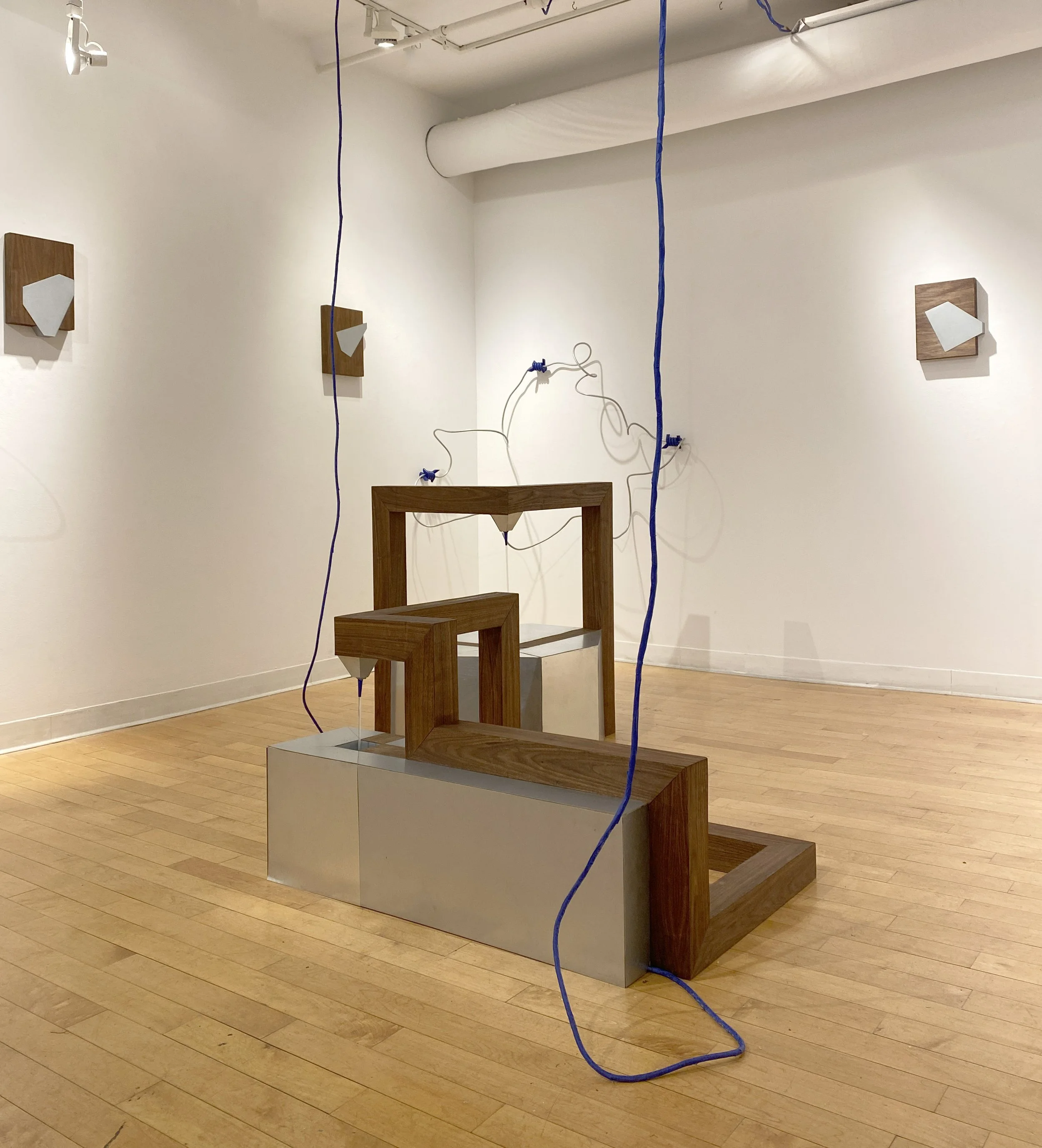
Virgilijs Tilks: , or ,
Center Gallery
March 5-29, 2026
Opening Reception: Friday, March 6, 5-8pm
Artists Talk: Saturday, March 14, 2-3:30pm
Press Release
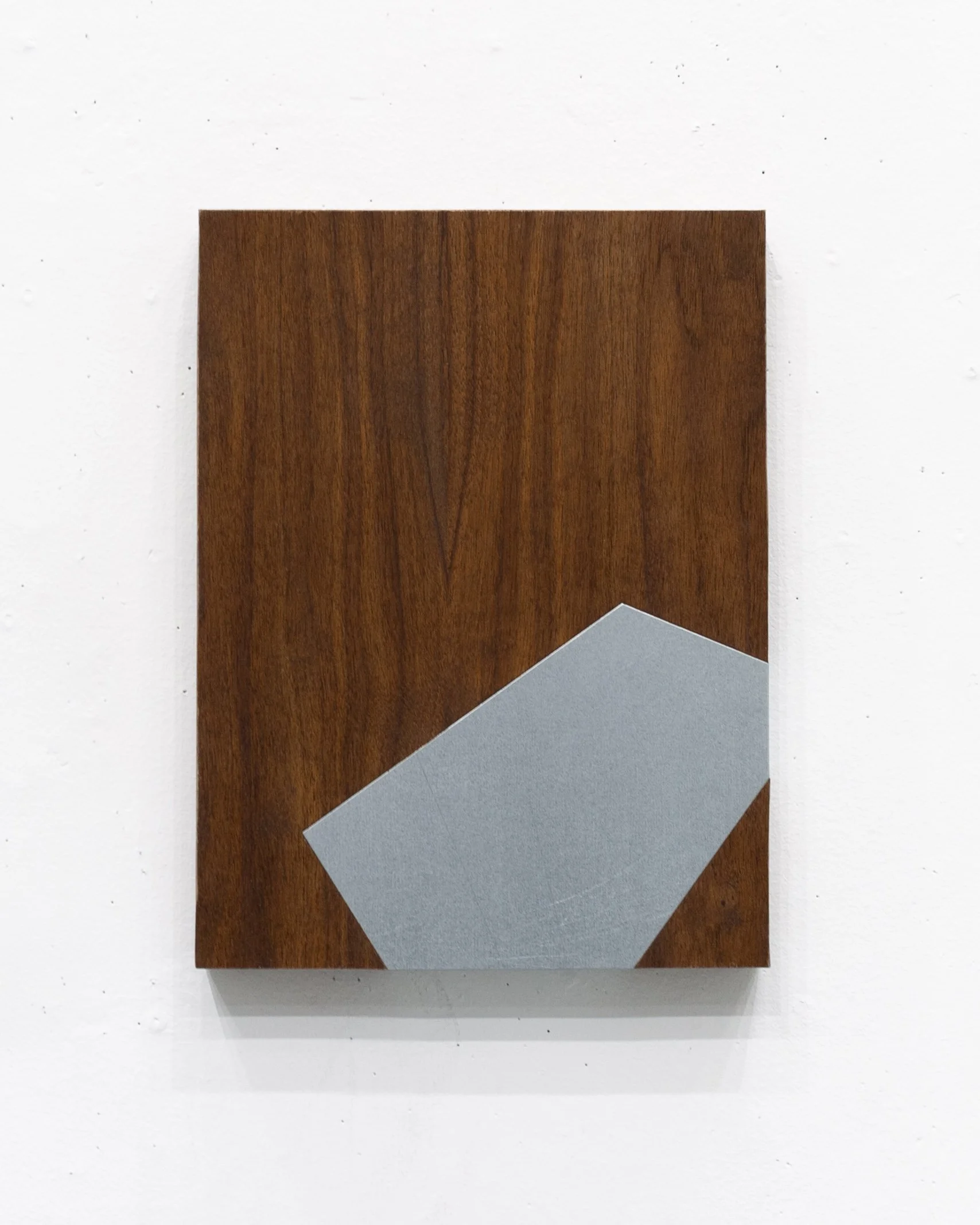
Line, Walnut veneer, galvanized steel, 9 x 12 x 1 ½ inches, 2025
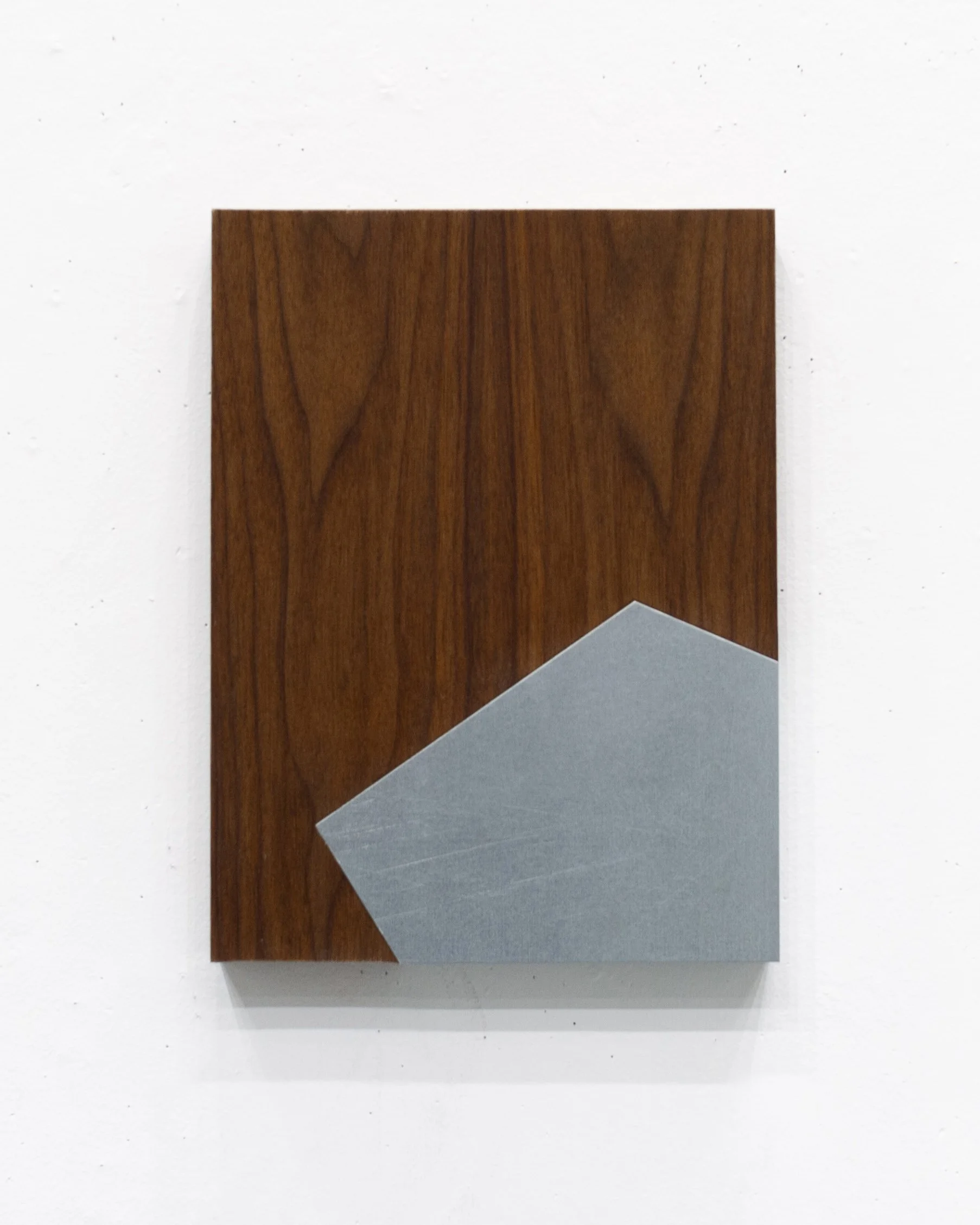
Gradient, Walnut veneer, galvanized steel, 9 x 12 x 1 ½ inches, 2025
Picture an object with no fixed form or name. When this un-object moves, does it displace the surrounding lines, or does it pass through them without interruption? If it does create a push, does that make it an object, simply because its limits are momentarily defined by what surrounds it? Or does a space remain where its outline is still unknown?
When time is present, outlines appear less as lines and more as gradients. Borders shift according to context, much like personal boundaries do. Perhaps it is not the borders themselves that distinguish an un-object from an object, but the moment in which those borders are perceived — the point at which “enough is enough,” only ever legible because “never enough” is already present. The threshold between these conditions is not fixed. It emerges through perspective, in the moment when the object senses a line and temporarily decides between “now” and “never.”
Once borders are fixed, the un-object becomes an object through form. Stability appears, along with the expectation of coherence. Yet an object does not always remain one. When it refuses to settle, the line between belonging and otherness begins to blur. The boundary softens, but the un-object persists. Movement disrupts the surrounding field. Boundaries dissolve and reappear elsewhere, no longer attached to a single form. Belonging and otherness are not stable states, but outcomes of this disruption — temporary positions shaped by proximity, motion, and attention.
Is it possible for the un-object and the object to coexist without collapsing into one another? If protection requires definition and enclosure, then the un-object cannot be protected without being destroyed. To protect it is to fix its border but to fix its borders is to undo the conditions that allow it to exist. Within overlap, borders do not harden into lines. They remain gradients. Here, care does not stabilize form, but allows permeability. The un-object persists not by being preserved, but by remaining exposed — held in relation rather than contained by boundaries.
The un-object exists where borders appear only as gradients, where “enough” and “never enough” collapse into perspective, and where protection becomes indistinguishable from destruction. It asks whether care can exist without enclosure, and whether something can remain alive only by refusing to stay one.
Artist Bio
Virgilijs Tilks graduated from the Visual Communication department at the Art Academy of Latvia in 2023, where they participated in an exchange program at the Berlin Art University (UdK), studying exhibition design. During their studies, they worked as a gallery assistant and co-directed an artist-run gallery in Riga, where they also curated exhibitions. After graduation, they moved to Boston, where they have actively participated in the art community since. In 2024, alongside participating in group shows, they did their first solo show at Shoe Bones gallery in Salem. In the summer of 2025, they merged artists from Europe and Boston to participate in the exhibition In the Shadow of the Floater at the Distillery gallery in South Boston.
Virgilijs primarily works with sculptural elements, photography, and digital assets to create immersive narratives that blend physical and digital space. Architecture, photography, and visual communication studies have helped them develop an interdisciplinary approach to explore how spatial relations and visual imagery can merge to create dynamic, multi-dimensional experiences. They are particularly drawn to the space where the tangible and digital meet to create new possibilities for perception and storytelling.
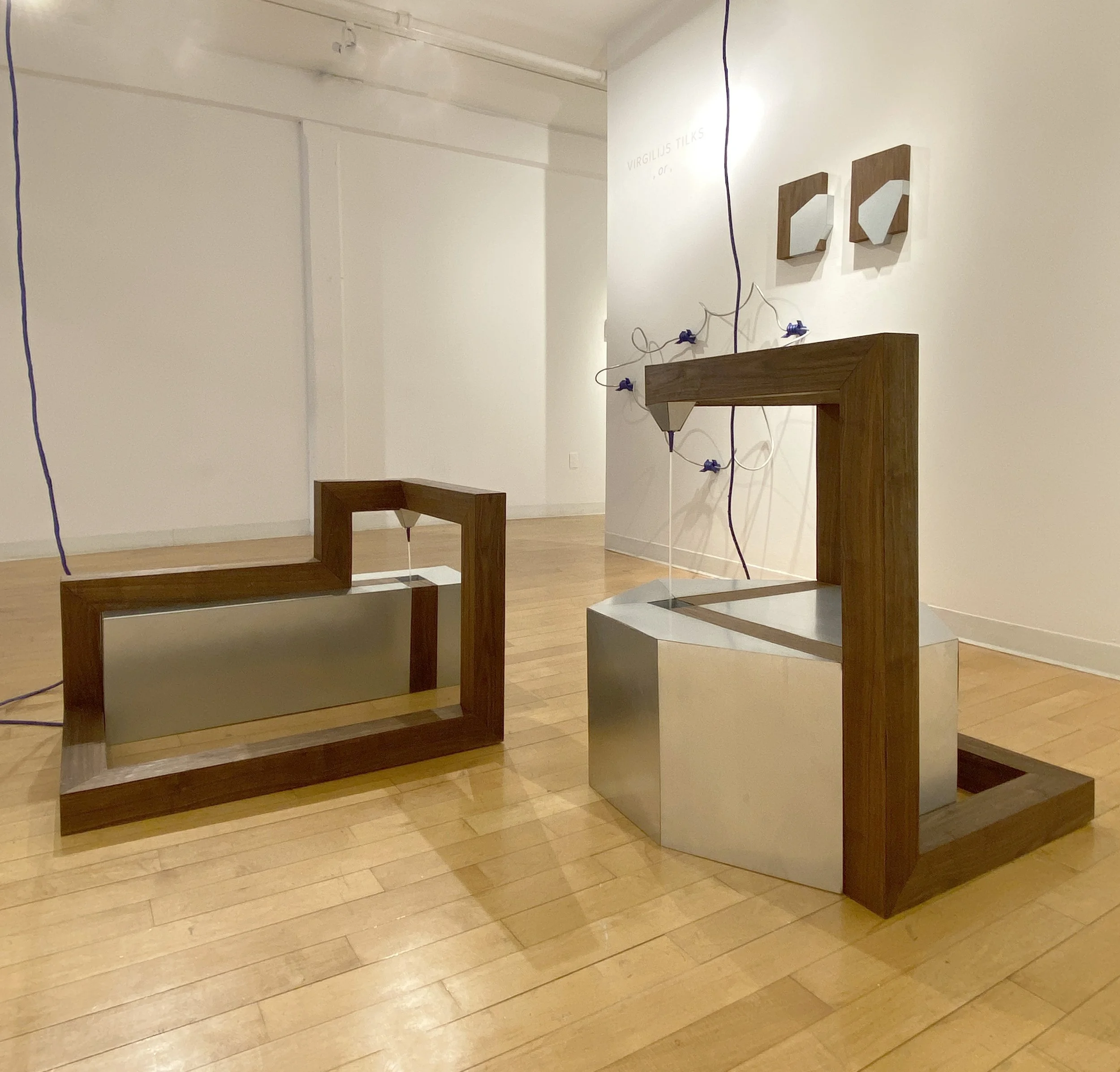
A Border Still Deciding (L), Where the Line Appears (R), Walnut veneer, galvanized steel, water, 2025/26