
Mira Cantor: Mirror, Mirror
Main Gallery
December 3-27, 2026
Opening Reception: Friday, December 4, 5-8pm
Press Release
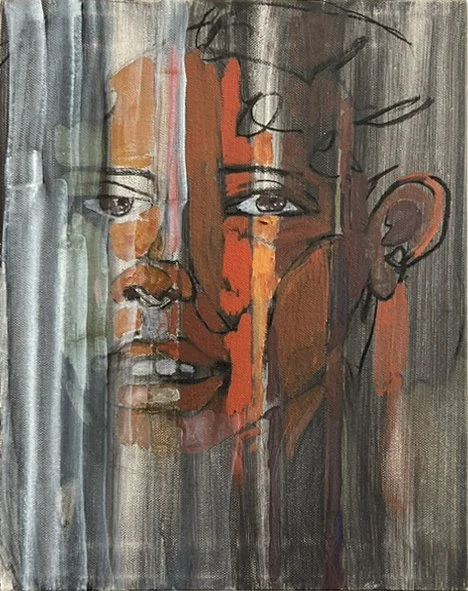
Mira Cantor, Reflection, acrylic, 11 x 14 inches, 2026
Artist Statement
A year after retirement, I will show portraits and busts, new paintings and drawings, addressing the incredible colors of skin. Looking at ourselves and each other takes courage.
My work has been influenced by Greek and Roman portrait artists of the Renaissance - Picasso, Van Gogh, and Goya. The space between the artist and the model is intimate; we are both looking towards each other inside an imaginary box. Capturing the essence and soul of a model can only be done in real time. I cannot work from photos. I must be inside this box with the model, having a conversation without words.
We have been obsessed with gold, its beauty and power since it was unearthed. The use of it in art and decoration goes back through ancient history. In painting, the use of gold for saints’ halos gave them an ethereal presence and continued to bring a godly aura to work throughout the Medieval World. Gold frames added power and prestige to paintings, particularly portraits in the Renaissance. The frame on the Mona Lisa is larger in area than the painting. Now, in the present, we have a US president, a modern-day Midas, who thinks the power and prestige of gold should decorate everything he touches, subverting its beauty into a tacky display of excess.
We are all the same and different. No two people look alike anywhere in the world. Pretty fascinating, physiologically! Yet, we all function with the same biological systems that give us life. We all have different colored skin: a beautiful range of beiges and browns and ochres and purples. It is something to pay attention to and admire, examine, and enjoy. We have been brainwashed to believe that Snow White is the fairest, best, most beautiful as the story is told. Disney was a racist; I grew up with Disney. Racism has lurked in the background my whole life and still does. Its shadow is pervasive; it's everywhere.
The drawings in this exhibition are busts of our contemporaries nodding to history. The paintings are framed in gold leaf, emphasizing each human as a special being. My work has often focused on ideas that force integration. Can we look at skin as beautiful colors that are naturally made? We have names for them in paint; ivory, sienna, honey, sand umber, beige, bronze, almond, amber, gold, chocolate, espresso, olive, porcelain, alabaster, chestnut, copper, etc., which we admire in paint but not on actual skin. Look again, admire the beauty of colored skin.
I am a white woman and a product of the '60s, a time when there was segregation even in the North. However, I went to integrated schools in the Bronx that segregated classrooms for those who were college-bound and those who were not. My father worked in Harlem, and on Saturdays he would take me to work with him, lock me in the car, and visit his customers. I would peer out the window at people who were dark-skinned living their lives. Fast forward to my first portraits of people, both black and white, sewn out of canvas that were dressed and painted. These life-size figures were installed as vignettes showing how people are forced to integrate at beaches, doctors' offices, and in elevators. Then came the series called “Skin,” where 9/11 integrated people in death and destruction. Paintings in pink and black grids of dots in a multitude of skin tones looked at skin under a microscope. In my last show, “Woven,” I used watercolors to integrate and weave together legs in skin tones dancing together as a unit.
In this show “Mirror, Mirror” I draw from my friends and people who are in my life at this time.